
Voice AI Support: How Conversational Technology Enhances Customer Service

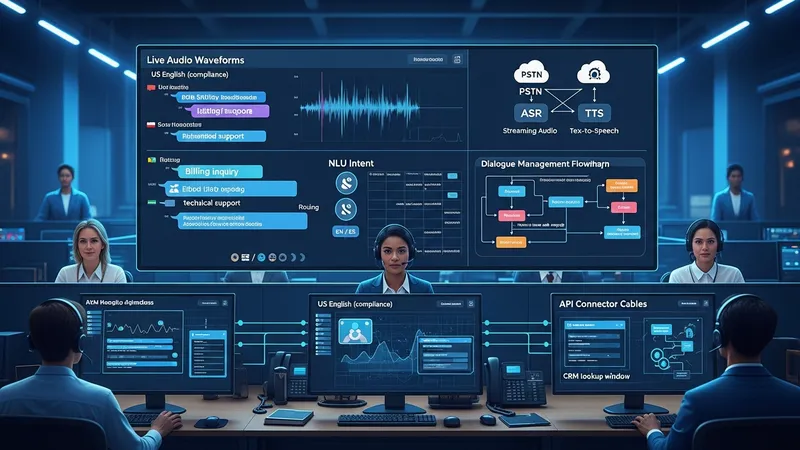
Types and components of voice AI support in customer service
Voice AI support commonly comprises several interoperable components: automatic speech recognition (ASR), natural language understanding (NLU), dialogue management, text-to-speech (TTS), and integration adapters for telephony and back-end systems. In United States contact centers, ASR and TTS are frequently provided by cloud services that can accept PSTN or SIP audio streams. Dialogue managers may be rule-based or driven by statistical or neural policies that determine how the system responds. Integration adapters map intents and entities from the conversational layer into actions such as CRM lookups, ticket creation, or agent transfers.
Component selection often depends on specific functional requirements. For example, an organization that needs strong transcription for compliance review may prioritize ASR providers with established performance on US English; one that needs multilingual routing may seek platforms with robust language detection for Spanish and other languages common among US callers. Many US implementations mix vendor services—using one provider for ASR and another for dialogue management—so interoperability and API compatibility are key practical considerations.
Telephony interface and call routing elements are essential parts of voice AI deployments in the United States. Interactive voice response (IVR) platforms that accept speech input are often adapted to route calls based on predicted intent. Call routing rules may incorporate predictive analytics such as estimated handle time or agent skill matching. Considerations such as latency introduced by cloud round trips and the ability to operate during network outages inform whether organizations choose hybrid architectures combining cloud and local routing logic.
Voice AI components also intersect with quality-control systems used in US contact centers. Transcripts produced by ASR can be used to populate speech analytics tools that detect trends or compliance issues. Test data sets that reflect the diversity of US callers—regional accents, background noise typical of mobile calls, and domain-specific terminology—are commonly used to benchmark component performance before wide deployment. These evaluations typically guide iterative improvements rather than serving as one-time certification.