
Welding Equipment Basics: Essential Tools And Their Functions Explained

A functional overview of common tools and equipment used for joining and cutting metals focuses on categories of devices rather than specific purchasing guidance. This overview describes how electrical power sources, hand-held torches, consumable electrodes and filler wires, gas regulators, clamps, and personal protective equipment typically interact in a welding or fabrication setting. The aim is to clarify primary functions: creating and controlling the heat source, supplying filler or flux, protecting operators, and holding workpieces to permit accurate metal fusion.
These tool categories are used across construction, industrial maintenance, and shop fabrication in the United States and often vary by process: gas metal arc welding (GMAW or MIG), gas tungsten arc welding (GTAW or TIG), and shielded metal arc welding (SMAW or stick). Equipment choices may reflect material type, thickness, joint geometry, site conditions, and applicable safety rules from U.S. regulators and standards organizations. The following examples illustrate representative items commonly encountered in these environments.
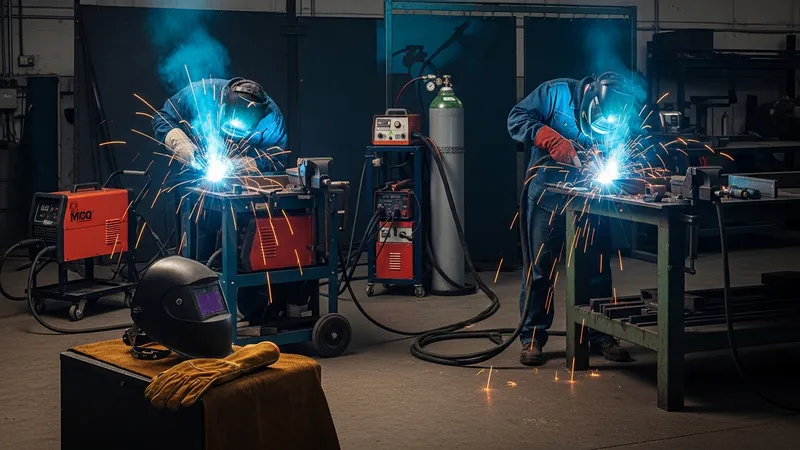
- MIG (GMAW) welding machine and wire feeder — a power source paired with a wire feed mechanism that supplies continuous consumable wire and common shielding gas combinations such as argon with CO2 blends.
- TIG (GTAW) torch and high-frequency-capable power source — a torch that delivers a non-consumable tungsten electrode and inert shielding gas, often used for thin stainless steel or aluminum applications.
- Stick (SMAW) electrode holder and compatible electrodes (for example, low-hydrogen rods) — a simple power source and holder used for field repair, structural steel, and outdoor applications where shielding gas is impractical.
Power sources for welding may be transformer-based or inverter-based and can deliver constant current (CC) or constant voltage (CV) outputs depending on the process. In the United States, lighter consumer units for hobby or small fabrication tasks may cost approximately $200–$1,200, while industrial inverter systems used in shop and plant work may range higher; these figures are indicative and may vary. Duty cycle, portability, input voltage (120V vs. 240V), and control features often determine perceived suitability for a particular process rather than an absolute measure of quality.
Consumables such as filler wires, electrodes, fluxes, and shielding gases serve distinct metallurgical roles. Choice of filler metal is typically matched to base metal chemistry and mechanical requirements; for example, certain electrode classifications used in structural steel are widely referenced in U.S. welding practice. Shielding gas selection may influence penetration and arc stability, and regulators and hose assemblies are used to control flow from compressed gas cylinders compliant with U.S. Department of Transportation (DOT) rules and workplace standards enforced by the United States Occupational Safety and Health Administration (OSHA).
Personal protective equipment (PPE) commonly includes welding helmets with appropriate filter shades, flame-resistant clothing, welding gloves, and respiratory protection when fume levels may exceed recommended exposure limits. U.S. employers and operators typically consult OSHA guidance and standards for eye, face, and respiratory protection; relevant sources include the OSHA welding, cutting, and brazing safety guidance and consensus standards such as those from the American Welding Society (AWS). Selection of PPE often reflects welding process, material type, and workplace hazard assessments.
Clamping, grounding, and workholding fixtures play a supporting role by stabilizing parts and ensuring reliable electrical return paths for arc processes. Portable grinders, wire brushes, and chipping hammers are commonly paired with welding operations for joint preparation and post-weld cleaning. Other accessories such as preheat torches, thermal cutting tools, and extraction devices for fume control often appear in larger shops; their presence may relate to local job requirements or code considerations rather than individual operator preference.
Equipment maintenance and regulatory compliance are central to safe and effective welding operations in the United States. Regular inspection of cables, leads, regulators, and PPE along with adherence to OSHA and DOT rules for gas cylinder handling can reduce operational disruptions and exposures. The next sections examine practical components and considerations in more detail.