
Cyber Security For Firms: Key Principles For Protecting Business Data

Encryption, backup, and data lifecycle protection for business data
Encryption aims to protect data confidentiality both in transit and at rest. U.S. guidance often recommends industry-standard algorithms and documented key management practices. Firms may use transport-layer security (TLS) for web and API traffic, and storage-level encryption for databases and backups. Keys may be managed in hardware security modules or cloud key management services, with separation of duties for key custodians often applied to reduce insider risk.
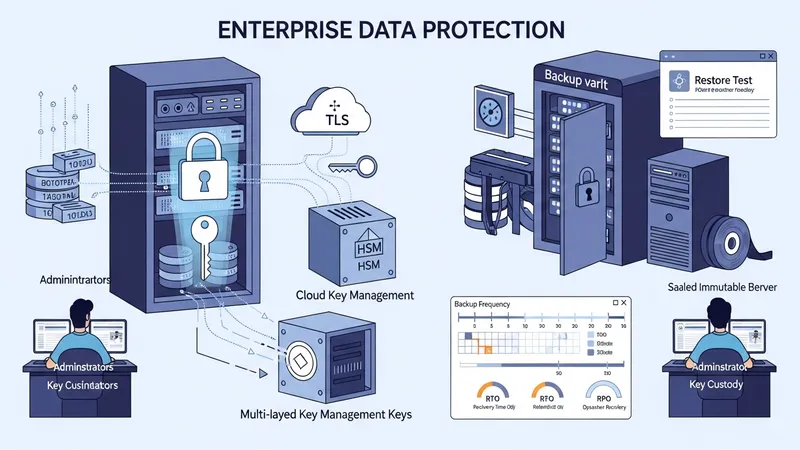
Backup strategies typically define which data is protected, backup frequency, retention periods, and restoration procedures. In the U.S., organizations may implement immutable or air-gapped backups to reduce the risk of modification after an incident. Regular restore tests often reveal configuration issues or data integrity problems, and test results may inform adjustments to backup cadence and scope to align with recovery time and recovery point objectives.
Data lifecycle policies help determine where and how long data is retained, and when it should be securely disposed. Mapping data classifications to handling requirements may assist in applying encryption, access controls, and backup priorities consistently. For regulated sectors in the United States, retention and disposal policies can interact with legal and compliance obligations, so documentation and audit trails frequently accompany lifecycle decisions.
Practical considerations include cost and complexity trade-offs. Stronger encryption and longer retention can raise storage and key management burdens, and frequent backups may require additional bandwidth and compute resources. Many U.S. firms prioritize protections for sensitive categories—such as personally identifiable information or intellectual property—while applying more standard controls to lower-risk datasets to balance resources and protection needs.