
Data Leakage: Overview Of Risks, Causes, And Security Implications

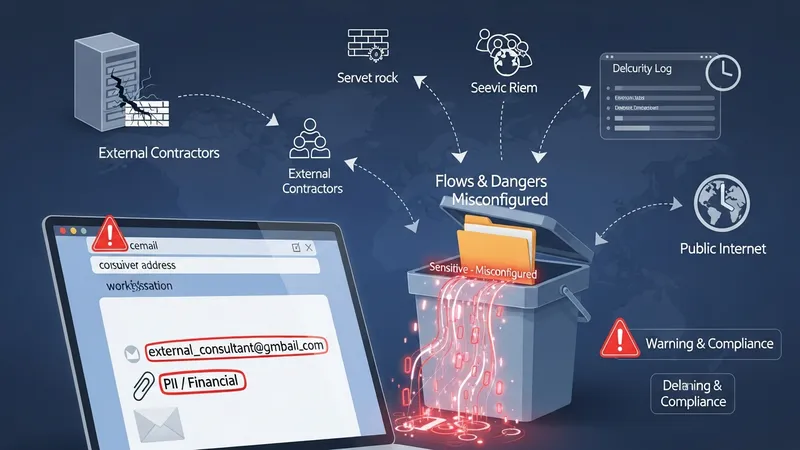
Unintended exposure or transmission of sensitive information within digital systems occurs when data that should be protected becomes accessible to unauthorized parties. This can involve personally identifiable information, financial records, intellectual property, or proprietary business data. Exposure may happen through technical failures, human mistakes, inadequate processes, or deliberate misuse. The resulting flows of information can be internal (between employees or applications) or external (to contractors, cloud services, or the public internet). Understanding how data moves and where controls typically fail helps clarify what is meant by this class of incidents.
Incidents of information exposure often involve multiple factors acting together rather than a single point of failure. For example, an employee email with sensitive content may be sent to the wrong recipient, a cloud storage container may be misconfigured, or a third-party integration may leak identifiers that enable broader access. Detection can be delayed when logging and monitoring are incomplete. In United States contexts, organizations may also face legal and regulatory reporting requirements when certain categories of data are exposed, which can influence prioritization of detection and response activities.
- Microsoft Purview Data Loss Prevention — policy-driven DLP features integrated with Microsoft 365 that can identify and help control sensitive content across mail and files; typically deployed within enterprise Microsoft subscriptions.
- McAfee Data Loss Prevention — an endpoint- and network-focused DLP product suite that can discover, monitor, and protect data across endpoints, networks, and cloud services; often used in regulated industries in the United States.
- Varonis Data Security Platform — a data-centric security tool that maps data access, highlights excessive permissions, and can assist in identifying potential exposures on file systems and cloud stores; commonly applied to file shares and collaboration platforms.
Data protection tools such as those listed may be part of a broader defensive architecture but typically address only certain vectors. Agent-based endpoint controls can detect data movements from a device, while network or gateway controls may look for sensitive content in transit. Cloud-native controls focus on SaaS and object storage. Selection and configuration of these tools often require mapping where critical data resides and understanding workflows that create legitimate data flows. Implementations may involve trade-offs among usability, coverage, and operational cost in United States enterprise settings.
The human element frequently contributes to exposures and can include inadvertent disclosure, misuse, and insufficient training. In many United States incidents, misdirected emails, shared links with overly permissive access, and improper use of personal storage accounts have been implicated. Organizational policies, access reviews, and role definitions can reduce likelihood but may not fully eliminate risk. Detection capabilities that surface anomalous sharing patterns or access spikes can help identify human-originated exposures sooner, though such systems often require tuning to reduce false positives.
Technical misconfigurations remain a common cause in cloud and on-premises environments. For example, publicly accessible storage containers or overly permissive access control lists can expose large datasets. In the United States, multiple high-profile disclosures have involved misconfigured cloud storage or unsecured APIs. Regular automated scanning and inventory of data stores, combined with clear change management and baseline configurations, can help find configuration drift. However, tools alone may not prevent exposures if organizational processes do not enforce consistent configurations.
Third-party and supply-chain relationships also influence leakage risk. Integrations with vendors, contractors, and platform providers can create additional paths for data to leave an organization’s control. Contractual protections, vendor security assessments, and least-privilege integration patterns can reduce exposure but often require sustained governance effort. In the United States, contractual and regulatory obligations may dictate specific controls or reporting timelines when third-party access is involved, adding a compliance layer to technical remediation choices.
Detection, monitoring, and logging capabilities typically determine how quickly an exposure is identified and contained. Security information and event management (SIEM) solutions, cloud-native logging, and DLP telemetry can provide signals of suspicious transfers or data copying. In many United States organizations, gaps in log retention, inconsistent telemetry coverage, or siloed visibility across cloud and on-premises systems can delay detection. Investing in consolidated visibility may improve response times but usually requires careful planning to integrate diverse sources of telemetry and to preserve privacy and legal considerations.
In summary, unintended exposure of sensitive information arises from intersecting human, technical, and third-party factors and is influenced by organizational controls and regulatory context. The examples above illustrate representative data-centric tools that often form part of mitigation strategies used in United States environments. Subsequent pages examine practical components and considerations in more detail.