
Phoenix Air Conditioning Service: Key Factors To Consider In The Desert Climate

In hot, arid urban settings such as Phoenix, cooling system service revolves around managing persistent high ambient temperatures, elevated solar loads, and frequent dust intrusion. The concept involves routine inspections and maintenance tailored to long operational hours and coarse airborne particulates that can reduce heat-exchange efficiency. Technicians and property managers often evaluate system runtime patterns, heat-transfer surfaces, control calibration, and component wear to maintain cooling capacity. Attention to outdoor condenser performance, indoor airflow balance, and moisture control in specific building assemblies forms the practical core of servicing decisions in this climate.
Service in a desert environment typically emphasizes preventive activities that address accelerated component stress. This may include cleaning condenser coils more often, checking refrigerant charge given extended run times, and verifying fan motors and compressors under higher load cycles. Building envelope factors such as attic radiant barriers, window shading, and insulation levels can influence service priorities because they affect internal heat gain and the resulting cooling demand. Those managing or maintaining systems may prioritize interventions that preserve system capacity and reduce energy consumption without assuming uniform outcomes across different building types.
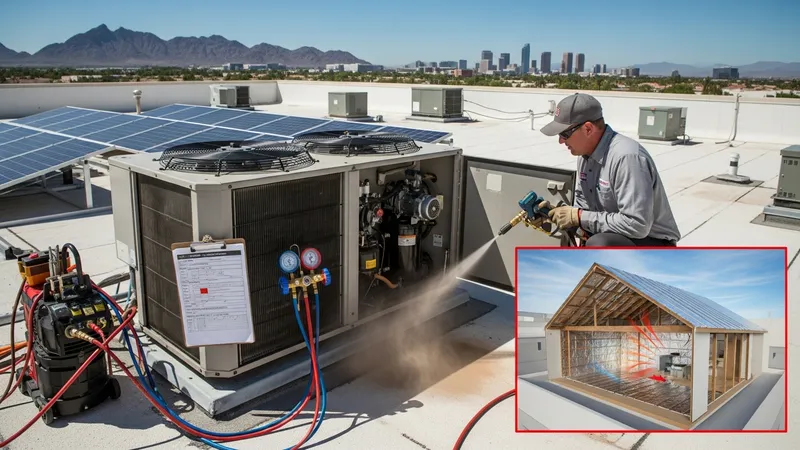
- Scheduled preventive maintenance: Routine checklist items such as condenser coil cleaning, lubrication, refrigerant pressure checks, and safety control tests that are commonly referenced for sustained performance.
- Air filtration and duct maintenance: Use of higher-efficiency filters and attention to duct sealing to limit dust ingress and maintain airflow; filter change frequency may increase in dusty settings.
- Component-level inspection and repair: Targeted assessments of compressors, reversing valves, contactors, and condensate drains that may show accelerated wear under extended summertime operation.
Comparative frameworks for service frequency often reflect local climate intensity and occupancy patterns rather than fixed schedules. In Phoenix-area residences and small commercial buildings, systems may run many hours per day during peak months, so service cycles typically occur more often than in temperate regions. Cost and resource trade-offs are framed around estimated runtime, equipment age, and indoor air quality needs. Neutral selection criteria for maintenance actions usually include observed airflow, measured refrigerant pressures, electrical draw, and visible coil condition rather than promotional metrics or guaranteed outcomes.
Operational diagnostics commonly employ straightforward measurements that can indicate declining performance without assuming a single cause. Technicians may use static pressure readings, temperature split across the evaporator, and amperage draw to assess system health. These indicators often point to issues such as restricted airflow, reduced refrigerant charge, or failing motors. In desert climates, dust accumulation on coils can mimic refrigerant problems by reducing heat transfer, so interpretation of measurements often considers recent environmental exposure and recent filter change history.
Energy-consumption patterns in arid climates can influence maintenance priorities and component choices. Higher seasonal cooling loads may make variable-speed compressors and multi-stage systems relevant because they can run at lower capacity for long periods, potentially reducing cycling stress. Evaluation of such equipment generally considers upfront cost, expected operating patterns in the local climate, and projected efficiency under sustained high ambient temperatures. Information from U.S. government sources such as the Department of Energy may help frame efficiency characteristics without implying a universal recommendation.
Indoor air quality concerns and filter selection in desert settings balance particulate removal against airflow resistance. Increasing filter efficiency can reduce dust deposition on coils and duct surfaces, but higher-efficiency media often increases pressure drop across the system, which may affect blower performance if not matched to the unit. Duct sealing and targeted cleaning can reduce dust recirculation. These interventions are usually evaluated for their likely impact on cooling capacity and maintenance intervals rather than presented as absolute fixes.
In summary, service considerations for cooling systems in hot, arid urban areas center on managing extended runtime, dust-related losses in heat-exchange efficiency, component stress, and building-envelope interactions. Typical responses include more frequent coil and filter maintenance, attention to refrigerant and electrical diagnostics, and assessment of ventilation and duct integrity. The next sections examine practical components and considerations in more detail.