
Voice AI Support: How Conversational Assistants Enhance Customer Service

Speech recognition and language processing for Australian customers
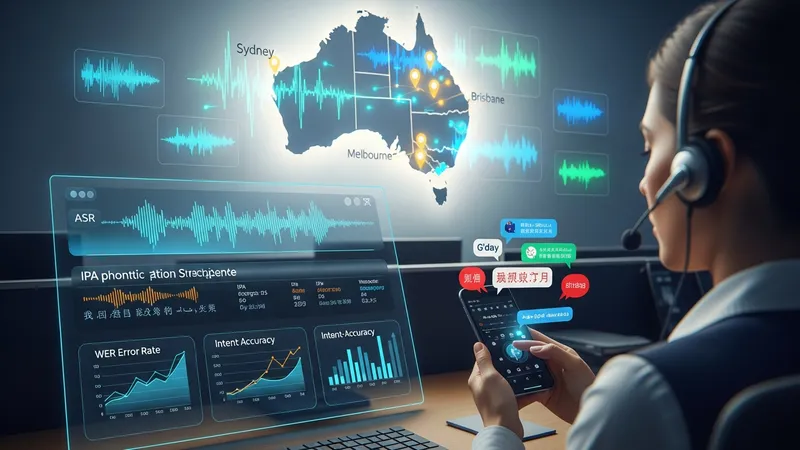
Speech recognition and NLP components used in Australia must account for regional accents, colloquialisms, and multilingual demand. Australian English presents phonetic patterns and local vocabulary (place names, slang) that can affect word error rates if models are trained on non-local corpora. Additionally, service providers in Australia may need to support languages commonly spoken by customers, such as Mandarin, Arabic, Vietnamese, and others. Models tuned with local voice samples and domain-specific lexicons typically perform better; organisations often arrange controlled data collection or vendor-led adaptation to improve recognition on real traffic.
Model evaluation in Australia may involve hold-out test sets drawn from local call recordings to measure intent detection accuracy and ASR error rates under realistic conditions. Background noise from call channels, mobile connections, and customer environment can influence recognition outcomes; robust front-end processing like noise reduction and voice activity detection is often applied. Careful selection of confidence thresholds and fallback strategies (repeat, clarification, transfer to agent) typically helps maintain interaction quality when recognition confidence is low.
For multilingual support, conversational systems often provide language detection or explicit language selection in initial prompts. Transliteration and mixed-language speech are operational challenges in some Australian contexts; systems may need to detect code-switching or provide direct agent handover when language coverage is insufficient. Licensing and vendor support for local language models differ across providers, so Australian organisations commonly verify vendor language coverage and the process for adding new language models before deployment.
Privacy and consent considerations intersect with speech processing choices. Organisations operating in Australia commonly notify callers that speech may be recorded and processed and document how transcripts are stored and accessed, in line with guidance from the Office of the Australian Information Commissioner. Anonymisation or minimisation strategies for transcript data are often applied to reduce exposure of personal information during model training or analytics. These measures can be part of procurement and deployment planning.