
Welding Equipment Basics: Essential Tools And Their Functions Explained

Consumables, Torches, and Electrodes in Welding Applications
Consumables encompass filler metals, electrodes, and fluxes that become part of the welded joint or protect the molten pool during fusion. Electrode classifications used in the United States, such as those standardized by AWS and referenced in fabrication specifications, indicate tensile properties, usability positions, and coating types (for example, low-hydrogen or rutile coatings). Filler wire for MIG or TIG is typically specified by alloy type (e.g., ER70S-6 for mild steel or ER308L for stainless steel) and diameter; selection is often matched to base metal and desired mechanical properties rather than being universally prescriptive.
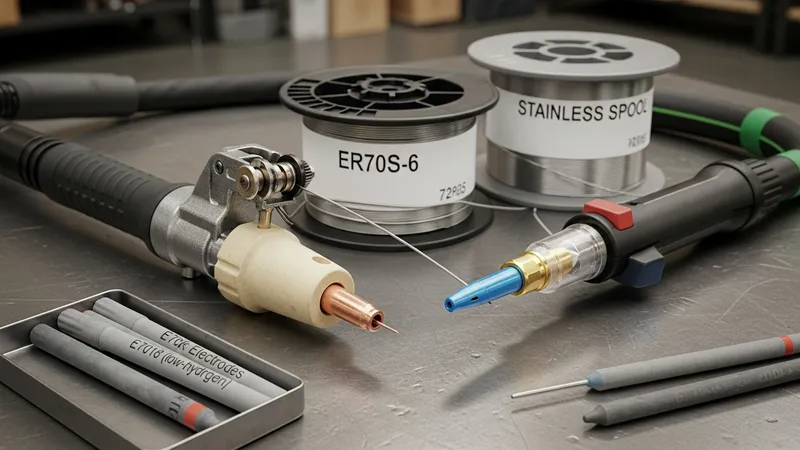
Torch assemblies differ by process: a MIG gun incorporates a contact tip and nozzle with integrated wire feed, while a TIG torch holds a tungsten electrode and directs inert gas to shield the arc. Consumable wear—tip erosion, nozzle spatter, and electrode degradation—affects arc characteristics and may require routine replacement. In U.S. shops, replacement schedules often follow observed wear patterns and quality checks. Proper maintenance of the torch, including insulation and gas lines, commonly reduces contamination and improves consistency without implying a single maintenance interval universally appropriate for all environments.
Shielding gas delivery and regulator selection play a metallurgical role by protecting the molten pool and influencing arc chemistry. Argon is commonly used for TIG on stainless and aluminum; argon–CO2 mixes are frequently used in MIG for carbon steel to balance arc stability and penetration. Regulators and flowmeters must be compatible with the cylinder valve standards found in U.S. supply chains and stored according to DOT and OSHA guidance. Gas flow rates are often expressed as cubic feet per hour (cfh) and adjusted per torch size and joint type rather than fixed values mandated across all contexts.
Electrode and filler selection may also reflect welding position, joint preparation, and post-weld requirements such as impact toughness or corrosion resistance. For example, certain low-hydrogen stick electrodes commonly used in structural settings are selected to reduce the risk of hydrogen-induced cracking in thicker sections. Welding procedure specifications (WPS) and procedure qualification records (PQR) commonly referenced in U.S. industrial practice document materials and consumable choices for reproducible outcomes in regulated work.